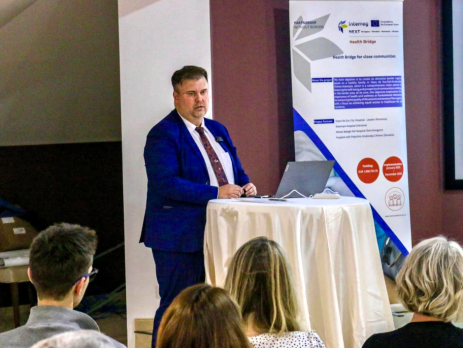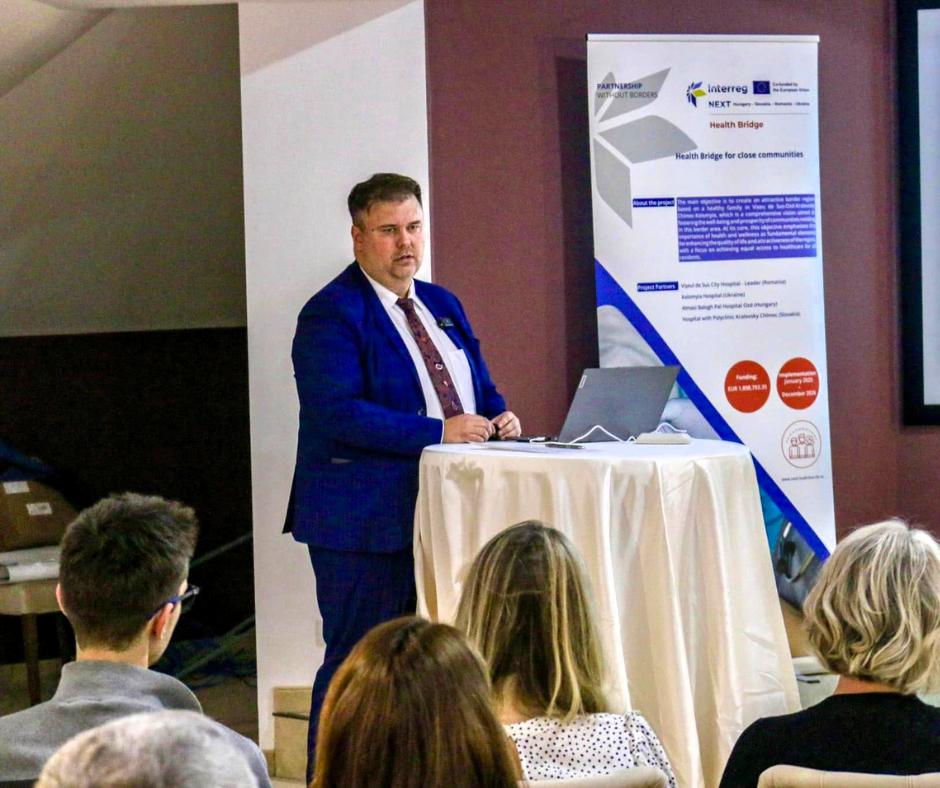
On February 28, the launch conference for the “Health Bridge” project was held in Viseu-de-Sus, marking the beginning of a new chapter in cross-border healthcare cooperation. Supported by the European Union under the Interreg VI A NEXT Hungary Slovakia Romania Ukraine 2021-2027 Programme, the project unites four border cities—Kolomyia, Ukraine; Viseu de Sus, Romania; Kralovsky Hlmets, Slovakia; and Ozd, Hungary—with a shared goal of improving healthcare services for local communities.
During the conference, partners officially presented the project’s mission and objectives, emphasizing the importance of enhancing healthcare quality and cross-border cooperation, with Vasily Koman, Mayor of Viseu-de-Sus, expressing his commitment to continuing and deepening ties with Kolomyia. The project partners include Kolomyyska Central District Hospital in Kolomyia, Ivano-Frankivsk region, Ukraine; Hospital of the City of Viseu-de-Sus in Viseu-de-Sus, Maramuresh County, Romania; Hospital of Almasha Baloga Pala in Ozd, Hungary; and Hospital with Polyclinic in Kralovsky Hlmets, Kralovsky Hlmets, Slovakia.
The key goal of the project is to improve healthcare service delivery and promote a healthy, family-oriented border region, enhancing well-being and prosperity in the partner cities while ensuring equal access to health services for all residents. Health Bridge innovations include the establishment of a new department of minimally-invasive surgery at Kolomyia’s Central District Hospital, equipped with state-of-the-art medical technology such as a narcotic respiratory machine, X-ray table, operating lamps, ultrasound machines, and more. Additionally, the project will involve epidemiological studies and clinical skills training for medical professionals.
The project will run from January 2025 to December 2026, with a total budget of €2,109,770.40, including an EU grant of €1,898,793.35, a partner contribution of €210,977.05, and a Ukraine-specific budget of €450,627.66.
This initiative will not only improve the quality of healthcare services but will also foster stronger cooperation between healthcare providers in these four border cities, sharing expertise and technologies for the benefit of local populations.